

How we do it
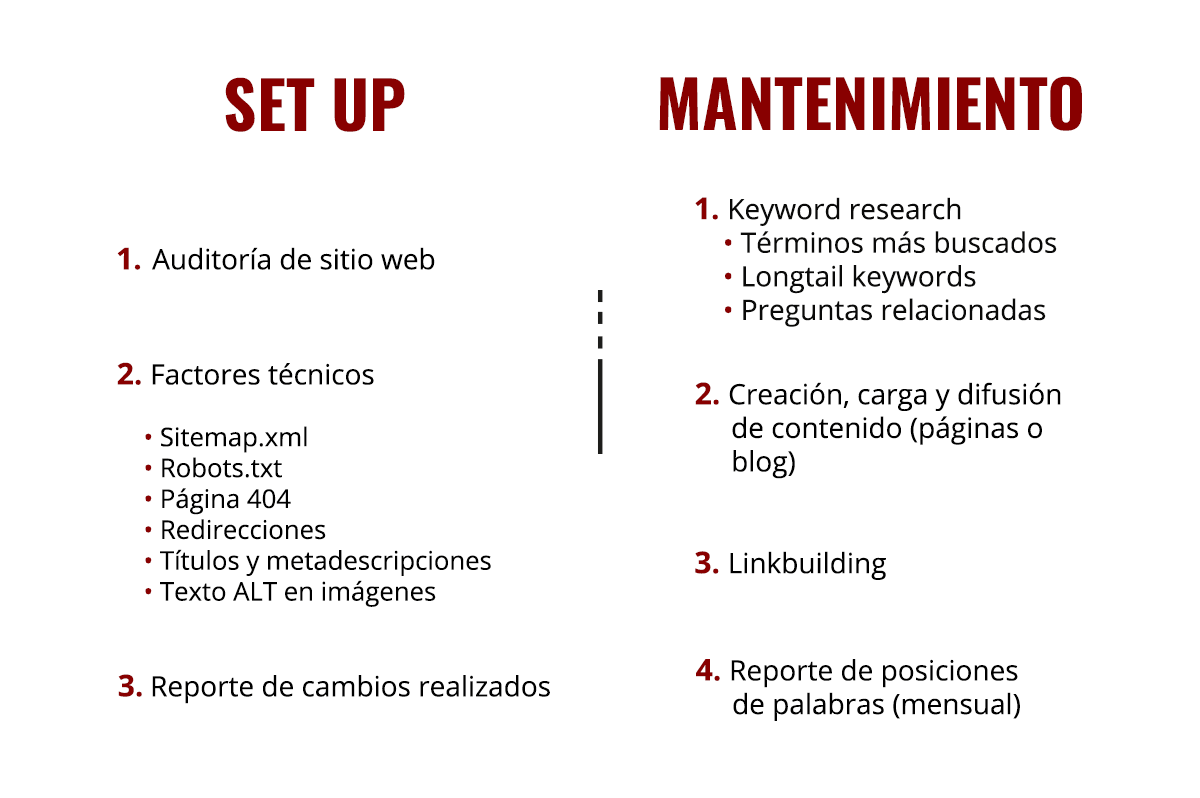
SEO process
Organic search engine positioning has two main types of optimization:
On-site SEO. This refers to all the factors within your website: how it is configured and how its content is written and tagged.
Off-site SEO. This refers to all the external factors outside your website that generate organic traffic, meaning they help people reach your page without the need to pay for advertising.
At Laetas, we provide an initial SEO setup for your website and monthly SEO maintenance.
Methodology for SEO setup
At Letras Laetas, we use an on-site SEO methodology in three simple steps:
- Website audit. We analyze the structure, content, and the way search engines are seeing your website.
- Technical error correction. Based on the previous analysis, we proceed to correct any technical errors your website may have.
- Report of completed changes. Once we make these changes, we prepare a report on the modifications and what they are expected to achieve, for example, ranking first on Google for a specific term.
1. Website audit
There are multiple tools for auditing a page’s SEO. The purpose of using them is to quickly detect a website’s areas of opportunity and proceed with its optimization.
2. Technical error correction
These are the main technical factors corrected in on-page SEO. If you are not familiar with the terminology, you can read more details on our blog:
Indexing and crawlability
- Sitemap.xml: This file contains all the URLs on your website and helps the search engine understand its structure and which content it should index. It can be described as your website’s index in the eyes of the search engine.
- Robots.txt: Unlike the previous file, this one tells the search engine which pages it should not index; for example, the login page.
- 404 page: If a user searches for a path that does not exist within your domain, for example, tiendademaria.com/pordeciralgo, they will reach this page, which will tell them that the content does not exist and invite them to visit another page on the site.
- 4xx and 5xx status codes: These refer to HTTP responses that are client or server errors. For example, verifying that there is enough storage space for a resource.
Redirects
- Non-duplicated HTTP and HTTPS: An SSL certificate verifies that a page is official. When installed, the site URL changes from HTTP to HTTPS, and it is necessary to make sure the installation has been done correctly.
- www and non-www versions: It is necessary to establish whether our website will be hosted on the domain with or without www, and to make an appropriate redirect to the preferred version without duplicating content.
- 301 and 302 redirects: If you change the URL of a page on your site; for example, if María changed tiendademaria.com/productos to tiendademaria.com/productos-y-servicios, the first address must redirect to the new one to avoid losing visits and authority.
- Pages with rel=“canonical”: If María’s site has an ecommerce with options to filter by price, best sellers, etc., this tag should indicate which page is the original to prevent search engines from identifying it as duplicate content.
On-page SEO: Tagging pages and images
Titles: The title is the name of your content. Ideally, it should be attractive, descriptive, contain a keyword, and have a specific length.
Meta descriptions: This is a tag that provides a brief summary of what each page contains. It is only visible in search engine results.
ALT text in images: Although we cannot see this tag, images should contain ALT text, which is what appears if a person’s internet connection is slow and images do not load. This tag is also added for accessibility reasons. With it, visually impaired people visiting your site can understand what your image is about through an audio tool.
3. On-page SEO report
An on-page SEO report may include the changes made to a site and what was achieved by making them; for example, how the site appears in search engines in terms of titles, meta descriptions, and the other aspects mentioned above.
Methodology for SEO maintenance
Our methodology for off-page SEO is divided into the following steps:
1. Creating a blog on the website
Having a blog helps you communicate with your potential clients. It is a very subtle and non-invasive form of advertising that provides them with useful information and keeps you in their minds for when they decide to buy something related to your business activity.
2. Research of relevant keywords
Before writing content for your blog, it is important to conduct keyword research. This will help you understand how users are searching the web for information related to your activities. A keyword study will help you determine:
- Ranking difficulty: Some words are more competitive than others, which makes them harder to rank for. By understanding the difficulty, you can choose the terms for which it is more feasible to appear.
- Long-tail keywords: Longer terms or keywords that are easier to rank for. For example, instead of trying to rank for “flower shop,” María may decide to target “flower shops in Mexico City with home delivery.”
- Related questions: Today, many users use search engines like an oracle, so you can use questions as subheadings in your content.
3. Writing and uploading optimized content
Once your intentions and the words you want to rank for are clear, the next part of the process is to write optimized articles and upload them to your site with the corresponding SEO parameters and tags.
4. Link-building strategy
Once those articles are on your site, they need to be set in motion through different social networks, internet forums, and other channels so more people can see and share them. It is also important to look for other websites that discuss topics related to your activity and get them to link to your page.
5. Off-page SEO report
Finally, unlike on-page SEO, you can measure the results of your content strategy quarterly by reviewing which positions you have gained in search engines. For example, in María’s case: “floral arrangements for weddings” ranking 1st on Google, “flowers for quinceañeras” ranking 3rd on Google, etc.
FAQ
Having a digital presence is essential for any type of industry. Organic search engine positioning ensures that our company appears on the first page of search engines and increases the chances of gaining new clients.
Organic search engine positioning, also called Search Engine Optimization or SEO, consists of a series of techniques to make a web page appear in the top positions on search engines such as Google, Yahoo, or Bing, and even on other platforms such as YouTube, without paying for ads.
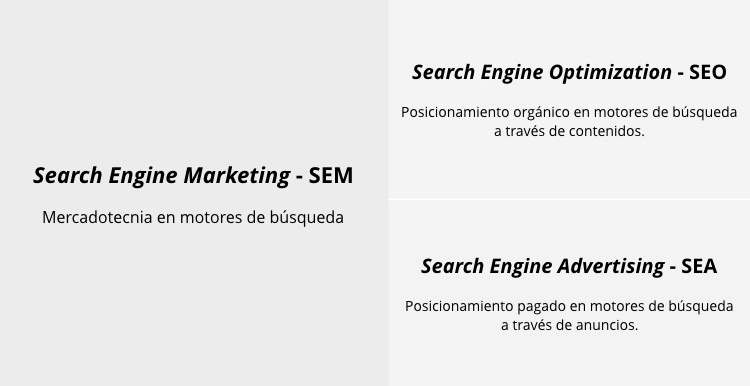
Together with Search Engine Advertising or SEA, it is part of what is known as search engine marketing or Search Engine Marketing (SEM). SEO, unlike SEA, is based on digital content to rank organically, meaning appearing in search engines without the need to pay for ads. By content, we mean any text, such as blog posts; images, such as photos, infographics, gifs, etc.; video; or audio, such as podcasts, that internet users find through the web. To learn more about the difference between SEO, SEM, and SEA, click on the image.
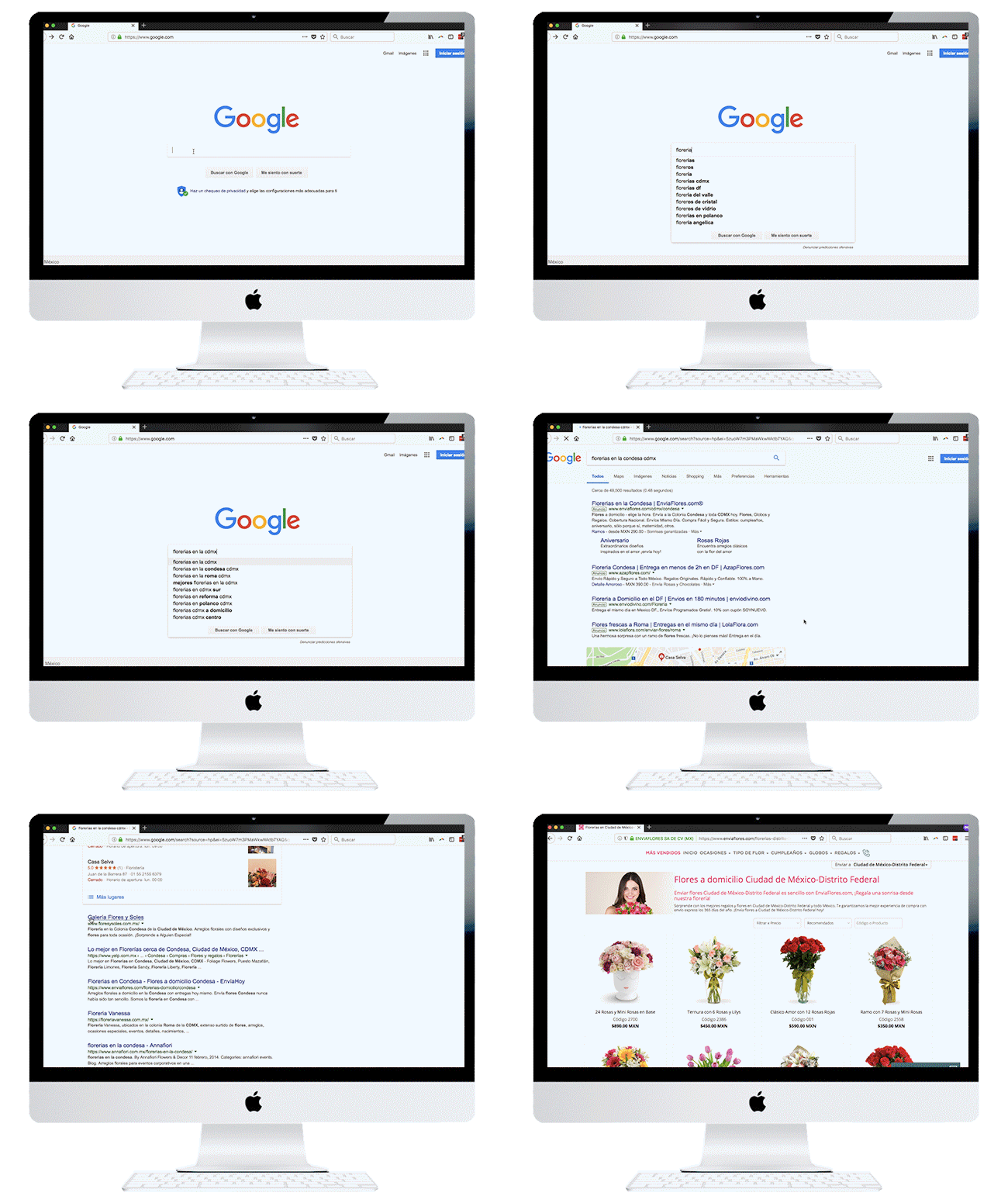
Let’s say, for example, that María sells flowers and has a shop in the Condesa neighborhood. She created a website through which she displays her catalog of products and services such as “floral arrangements for weddings,” “centerpieces for quinceañeras,” and so on.
SEO is responsible for the following:
- Technical aspects. Ensuring that María’s website is built in a way that search engines can understand its structure and content.
- Relevant content. Ensuring that the content María publishes on her page is valuable to her audience and is written using the terms people use to search for her services.
- Directory listings. Ensuring that María’s flower shop appears in the most common directories and those specific to her industry and location; in this case, for example, on Google, event planning directories, wedding directories, party venue directories, etc.
- Traffic sources: Ensuring that people reach María’s content not only through search engines, but also because:
– She was recommended on an internet forum
– They saw her on one of her social networks
– She was mentioned on another website about weddings or a topic relevant to her potential client
In this way, when a person located in the city where María’s shop is located searches Google for a term related to her services, they will reach her website. As María’s site becomes better optimized, it will gain domain and page authority, and the search engine will consider it more relevant.
SEO is a marketing strategy for anyone who has a website and wants a specific audience to reach it when searching for specific terms. It is useful for:
- Businesses that operate online, such as ecommerce, or that display their catalog of products or services online.
- Companies that want to reduce their advertising costs on Google, or SEA, Search Engine Advertising.
- Digital magazines that want their content to have good visibility in search engines.
- People with a project showcased on digital platforms: personal websites, work portfolios, among others.
Prices may vary depending on each project’s needs. An SEO quote can be prepared:
- By number of pages: The more pages to optimize, the higher the price. Optimizing a 10-page website is not the same as optimizing one with 1,600 pages.
- By number of terms and ranking difficulty: For example, if you want to appear for all the terms related to your products and services, it is necessary to study which ones would be most convenient and feasible to rank for, because, as we have seen, some keywords are more competitive than others.
YOU MAY ALSO BE INTERESTED IN…
A selection of articles from our blog.
Is your company looking for a content marketing solution?
We are ready to bring your ideas to life. Let’s talk about it!